Wednesday, August 29, 2007

Milkweed by Jerry Spinelli

The story of Misha Pilsudski, an orphan boy who lives with a band of juvenile thieves on the streets of Warsaw. We see the holocaust progress through Misha's naive eyes as he finds friends and an adopted family, then loses them all one by one to the Nazi soldiers he once admired.

My verdict: Spinelli is always great. "Stargirl" will make you laugh and cry on the same page, and "Maniac Magee" was one of my all-time favorites growing up. "Milkweed" is a historical fiction, and I was glad to see that it brought something new to the plethora of young adult novels centered around the Holocaust. It's touching but not too graphic. Misha is a lovable narrator, and the supporting characters are richly diverse. Misha has never known his own family, but is adopted by a band of boy thieves, then later by a young Jewish girl and her family. These relationships enrich his life, but also put him in danger and give him a heartbreaking firsthand view of the cruelties of the holocaust. The ending gets a little strange as the adult Misha seems to lose his mind for a while, but I think it's probably an accurate portrayal of what a lot of survivors were like. Identity and family are strong themes in the book, and in the end Misha finally finds both.

Although most of the characters in this book are fictional, Dr. Janusz Korkzac was a real person. He is a very minor character in this book, but knowing his full story really makes the brief mentions of him interesting. Dr. Korkzac was a highly respected psychologist who ran an orphanage and published a mountain of work on how children in any situation could be raised with love and dignity. Although he was not Jewish, he refused to leave his orphans when they were sent to the ghetto, and later to a concentration camp where his life was ended. It's a touching story, and one that should be told more often. "A Hero and the Holocaust" is a great place to start.

Tuesday, August 28, 2007

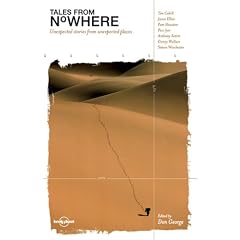
Tales From Nowhere edited by Don George


I finished this one a couple of months ago. Lonely Planet puts out an anthology of travel writing with a different theme every year. I love travel writing, and individually most of these essays are really good, but this book suffers from an ailment common to anthologies. Because they are all written to a single theme, after a while it's just too much of the same thing. For one thing, almost every single essay makes a point of including the word "nowhere", usually as "in the middle of nowhere", so that you can be sure they did, indeed, stick to the topic. Individually this is no problem, but after ten or twenty in a row it starts sounding cliche. And because they are all writing about "nowhere", the book as a whole comes across as a bunch of very well-traveled people having a one-up contest of "You think that's remote? That's nothing! Listen to this!"

But, like I said, individually these are all great stories. A few of my favorites:
* Grounded in In Bihn by Karla Zimmerman - When Zimmerman's bus breaks down in a tiny Vietnamese village she is befriended by the locals and comes to cherish the unique experience. Many of the essays have a similar theme, but this one is succinct, well written, and doesn't get overly dramatic about how "nowhere" the place is, or overly sentimental about how great it turns out to be. It's understated, and I like that.

* In the Wake of Albatrosses by Kery Lorimer - Lorimer and friends travel to Antarctica on a whim. Lorimer's vivid imagery is almost enough to make me wish I could have been there. Almost.

* The Worst Country In The World by Simon Winchester - Painfully hilarious. That's all I can say.

* On The Trail by Karl Tao Greenfeld - This stands out just because it is so absolutely heartbreaking. I really wanted to cry for the guy. Greenfeld went to China to write a book on SARS. For fifteen pages he describes in agonizing detail the difficulties of finding anyone willing to talk, and how after months he finally got on the right track, then spent months more persuing it, only to have his laptop with the nearly complete book and all his notes stolen. OK, maybe I don't recommend reading this one because it's so depressing, but it did stand out.

* The Living Museum of Nowhere and Everywhere by Rolf Potts - Potts is well-travelled and assumes that small town America has nothing to offer him, but finds some fascinating people and stories in a rural Kansas museum. The author is a little pompous in congratulating himself on still being able to enjoy the lowly midwest, even though it's no Paris, London, Myanmar, or India, but it's nice to hear a story that shows you don't have to risk dysentary to connect with "the world".

* A Visit to Kanasankatan by Jason Elliot - Elliot describes visiting a friend in a seemingly exotic place, filled with ethnic looking men, veiled women, shop signs in all languages, foreign sounds and smells, and poverty. In the end we learn his friend lives in North Kensington, London. It's a great twist. I'd love to use this as the basis for a writing assignment.

Monday, August 27, 2007

The Kabul Beauty School, by Deborah Rodriguez

I just finished listening to this book on my iPod. It is narrated by Bernadette Dunne. I love listening to audiobooks, but it's difficult to know whether I really enjoyed the book, or if the narrator made it better than it would have been if I had just read it myself. Anyway, for whatever reason, this was an enjoyable listen.

Here's the Publisher's Summary:

"Most Westerners working in Afghanistan spend their time tucked inside a military compound or embassy. Not Deborah Rodriguez. Here, she tells the story of the beauty school she founded in the middle of Kabul and of the vibrant women who were her students.

When Rodriguez opened the Kabul Beauty School, she not only empowered her students with a new sense of autonomy but also made some of the closest friends of her life. Woven through the book are the stories of her students: the newlywed who must fake her virginity; the 12-year-old sold into marriage to pay her family's debts; and a woman who pursues her training despite her Taliban husband's constant beatings. They all bring their stories to the beauty school, where, along with Rodriguez herself, they learn the art of perms, friendship, and freedom."

Here's what I have to add to it:

This is a nonfiction piece about a hairdresser who travels to Afghanistan as a volunteer in order to escape her abusive husband. Although her rudimentary emergency preparedness skills prove useless, she finds that hairdressers are in high demand. Hair salons were banned by the Taliban and their tools were destroyed, so the Afghan women have few skills and no supplies to rebuild their salons. Debbie realizes that hairdressing is one of a very few careers open to Afghan woman, and that with some training and supplies they can gain financial and personal independence that isn't available to them through any other means. So she decides to stay and open up a school.

I was amazed at the guts of this woman. She leaves behind everything in the states, including two grown sons, and moves to Afghanistan to oversee the school. Her feisty nature often clashes with the local culture - she confronts a groper in the market, stomps over to her Taliban neighbors' with a machine gun to demand they leave her guard alone, and embarrasses a beloved student by asking her to dance at a party. But she's also eager to learn about the culture and makes a sincere effort to understand her Afghani friends. She even agrees to an arranged marriage to an Afghani man who speaks little English and whom she's known only a couple of weeks! I loved the cultural insights and the personal stories of her students. It's obvious that she has a genuine love for them and that the Kabul Beauty School is making a real difference for the woman of Afghanistan. It's an engaging story with rich detail and a realistic but upbeat view of the world of Afghan women.

I Love Barnes (and Noble. Equally.)

I decided I need a blog to keep track of what I'm reading, so here it is. I hope you find something good here!