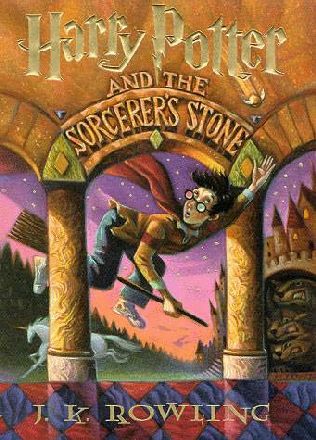
 Gavin and I just finished reading this one. One of the highlights of my day is hearing him ask for "Hewwy Pottow!" at bedtime. We read it in Spanish when he was a newborn. I don't really have much to write about it, though, because I've read it enough times to not need help remembering, and if you know me then you don't need to be told how much I love these books. I own them in nine languages and have been to the opening party of every book and movie since the beginning. If you haven't read it, quit priding yourself on not being a bandwagoner and just buy one already. And if you want an even bigger treat, get the audio version narrated by Jim Dale. The guy is incredible. I'd listen to him read the phone book. From an English teacher's standpoint I could point out a hundred reasons why Rowling is an amazing author, but I'll spare you all that. Rowling is wealthier than the Queen of England and she deserves every penny of it. Hooray for Harry Potter!
Tuesday, September 11, 2007
Harry Potter and the Sorcerer's Stone by J.K. Rowling
Gavin and I just finished reading this one. One of the highlights of my day is hearing him ask for "Hewwy Pottow!" at bedtime. We read it in Spanish when he was a newborn. I don't really have much to write about it, though, because I've read it enough times to not need help remembering, and if you know me then you don't need to be told how much I love these books. I own them in nine languages and have been to the opening party of every book and movie since the beginning. If you haven't read it, quit priding yourself on not being a bandwagoner and just buy one already. And if you want an even bigger treat, get the audio version narrated by Jim Dale. The guy is incredible. I'd listen to him read the phone book. From an English teacher's standpoint I could point out a hundred reasons why Rowling is an amazing author, but I'll spare you all that. Rowling is wealthier than the Queen of England and she deserves every penny of it. Hooray for Harry Potter!

Friday, September 7, 2007
Eat, Pray, Love by Elizabeth Gilbert
 Another travel book. This one is interesting because it's really not so much a travel book as a memoir of self discovery. Gilbert has a nervous breakdown in her thirties and realizes that she doesn't love her wonderful husband any more and can't bear the thought of having children. So she wallows in major depression for a while, goes through a long, nasty divorce, and finally decides that she needs to get her life in order. So she plans a year long journey; four months in Italy where she will do nothing but things that bring her pleasure. Except sex. Despite being surrounded by gorgeous Italian men, she swears off sex so she can discover who she is on her own, and not as part of a pair. So she learns to speak Italian, which brings her transcendental joy, eats a lot of pasta, and gains thirty pounds. Then it's off to an ashram in India to do yoga and meditate all day long, to get in touch with her spiritual self. Here we get a lot of hilarious dialogue with her inner self as she tries to concentrate on chanting for hours at a time but instead finds herself trying to decide whether her happy place should be a temple or an island or both and how to stop imagining jet skis zooming around her temple-island. Her final destination is Indonesia, where she hopes to learn how to balance the worldly enjoyment of Italy and the divine connection of India. She spends her days helping a hundred year old psychic painter with his English and her evenings partying with expatriates. She finally gives up her vow of chastity and finds true love, which you sort of expected all along. It's a funny, touching, soul-searching kind of book that leaves you wishing you could do exactly the same thing. (Except for the divorce and all that. I kind of like Dave. And Gavin, too.)
I checked out her website looking for an image to post, and it's worth a look if you enjoyed the book. She talks about how she became a writer and her advice for budding writers. Also, she answers some good questions about the book. In the FAQ she responds to " How can I possibly go on a journey like yours, given that I have a busy life of marriage, kids and work responsibilities?" I liked what she had to say, especially since I'd love to do something like this but obviously can't. She says, among other things, "The first question you can begin to ask yourself, though, is: “Where can I find a small corner of stillness?” I liked that. I feel like since I became a mom I'm not really sure who I am anymore apart from little Napoleon's serf. We touched on this in a church lesson I taught recently, too. Even if you can't take the year off to wander around the world, it's so important to find quiet moments to think and ponder and evaluate your life and whether it's going where you want it to. Gilbert says, "God resides in these pockets of silence. So where in your day, where in your home, where in your mind, is there some opportunity for a moment of silence? Or maybe even a few moments, during which you can start asking the questions you need to ask in order to find what you need to learn. Can you find the time to get out of your own way and try to step into your own light?" Kind of like Thoreau's essays on Walden, this book explores what it means to live deliberately.
Wednesday, September 5, 2007
Not So Funny When It Happened edited by Tim Cahill

Another great Travel anthology. Better than "Nowhere", though, because every story in it is hilarious. From bad haircuts to invading baboons, I enjoyed every bit of this book. Some of my favorites:
* Anne Lamott compares her oversize thighs to a pair of beloved maiden aunties in "The Aunties".
* Germaine Shames' Mexican lover proclaims his undying affection for her as she nearly drowns.
* Donald Katz shares his meeting with "The King of the Ferret-Leggers". An insane Irish man with a bunch of ferrets down his pants. How can this not be funny?
* A joke about what Adam and Eve received when God created them. Adam gets the ability to pee standing up, and Eve gets...you'll just have to read it.
The Farming of Bones by Edwidge Danticat
 Danticat is one of my favorite authors. I don't know why I'm drawn to her stories - they're always sad, fictionalized accounts of all the horrible things that happen in Haiti, especially between the Haitians and the Dominicans. She's a beautiful writer - I guess that's why I like her, despite the tone of despair that permeates her writing. The Greeks wrote tragedies because they believed that catharsis was good for the soul, and that's what Danticat's books offer - the experience of pain without actually having to go through it. And even though they are sad, they aren't without hope. The terrors of the past and present might be senseless, but there's always the feeling that if the future holds nothing better, we can at least hope to keep enduring.
"The Farming of Bones" is the story of Amabelle, an orphaned Haitian servant living in the Dominican Republic. Although her past has already been scarred by the Dominican hatred for Haitians, she is happy in her friendship with her mistress and her love for Sebastien, a handsome sugarcane cutter who promises to make her his wife and bring her back to Haiti where a better life awaits them both. But instead the nation erupts in violence against the Haitians, and Amabelle is left alone to bear the memories of all those she loses.
Tuesday, September 4, 2007
Saving Fish From Drowning by Amy Tan
 The Verdict: Unfocused and unpolished, but engaging and thought-provoking.
Amy Tan is one of my favorite authors. The novel she's most known for is "The Joy Luck Club", but I think "The Kitchen God's Wife" is her best work. "Saving Fish" is an interesting deviation from her typical themes of mother-daughter relationships and Chinese-American culture clashes. It's fun to read something new from her, even if it doesn't outshine the others. "Saving Fish" is the story of a group of American tourists in Burma/Myanmar who wind up kidnapped by a politically oppressed tribe. The books biggest weakness is that it tries to be everything - a bit of a mystery, part travelogue, semi-romantic, some comedy, some politics, and some tragedy. It's too much to pull together into a really good story, but it makes it interesting, too. I guess I feel like there are a lot of really good pieces to this book, even if they don't all come together perfectly.
I wondered for a while about the introduction, in which Tan claims to have dictated this story from the promptings of the deceased spirit of one Bibi Chen, a Chinese-American antiques dealer and humanitarian socialite. It's an interesting frame for the story, giving the book a, omniscient narrator who maintains a personally. This is perhaps the only book I've ever read with such a narrator, and the unique perspective provides some intriguing possibilities. I'd love to read more books with a narrator like this. The intro is as fictional as the rest of the book, however, as she assures us in this interview, which addresses a lot of other interesting points in the book. Bibi Chen never existed outside of Tan's imagination, but it's a great frame for a book that questions the line between fiction and reality.
I also enjoyed reading about the origin of the title. Buddhists believe in doing harm to no living thing, but often find justification to do just that. Tan tells the story of a Buddhist fisherman who goes out every day and pulls in thousands of fish in his nests, saying that he is saving the fish from drowning. He lays them on the shore where they obviously die. Then he takes them sadly to market, so as not to waste them, and uses the money to buy more nets so he can save more fish from drowning. One major theme in the book is intentions and consequences, and it's a frightening example of terrible things happening inadvertently despite good intentions, or very purposefully under the guise of good intentions.
I've never read anything before about Burma, but this book sparked my interest. I'm waiting for "Freedom From Fear" and "The Voice Of Hope" from Amazon, and I'm surprised at how often I hear the political situation there mentioned now. Jim Carrey even posted about it on YouTube. So without any mention of that stupid starfish story, I've decided that although I can't fix everything in the world, Jim Carrey has convinced me that I can do something about this. I'll post about Aung San Suu Kyi's books when I finish them and let you know how it's going. Want to join me? Check out Carrey's video to find out how!
Subscribe to:
Posts (Atom)
